The Elements of Plot (and Why They Matter)
April 4, 2025
Why Reviews Matter More Than You Think (Especially to Indie Authors)
May 2, 2025A Full Stop for the Oxford Comma: In Defence of My Favourite Tadpole
I’m definitely nerdy — there are no two ways about it. I’ve always suspected I’m a bit of a geek too, but it wasn’t until I realised I had a strong opinion about the Oxford comma that I knew it for sure. Full-blown grammar geek. No shame.
This is not a new revelation, by the way. I’ve cared — really cared — about the Oxford comma for years. I notice it everywhere: in books, articles, emails, packaging, social media posts... Like a hawk, I scan for that tiny grammatical tadpole. I don’t judge (well, not much), I just observe. Is it there? Is it missing? Was it left out on purpose, or was someone careless with their commas?
I love the Oxford comma.
But not everyone agrees, of course, and I’ve had a lot of fun looking into why people are so against this delightful little mark.
A Comma by Any Other Name
The Oxford comma, the serial comma, the Harvard comma, the series comma — it goes by many names, but it’s always the same thing: the comma that comes after the penultimate item in a list. Like this:
I had tea, cake, and scandal.
I found a great post over at Grammar Girl on the history of the comma. Interestingly, the term Oxford comma didn’t appear in print until 1978, but the concept dates back much further. In 1905, Francis Howard Collins published Author & Printer: A Guide for Authors, Editors, Printers, Correctors of the Press, Compositors, and Typists (catchy title, right?), where he quoted philosopher Herbert Spencer:
“Whether to write ‘black, white, and green,’ with the comma after white, or to leave it out and write ‘black, white and green’ — I feel very decidedly in favour of the first...”
Spencer argued that the comma gives each item in a list equal weight. And while nowadays the Oxford comma is mostly considered a stylistic choice (meaning neither option is technically wrong), clarity can sometimes hang in the balance.
Chaos Without a Comma
Let’s face it: some lists work fine either way. But others? They descend into deliciously unintentional chaos.
The internet is full of examples, but this one might be my favourite:

Now, as entertaining as it is to imagine Nelson Mandela moonlighting as an immortal collector of adult toys, I’m willing to bet that’s not what the writer intended. So, in the interest of family-friendly storytelling, let’s take another example:
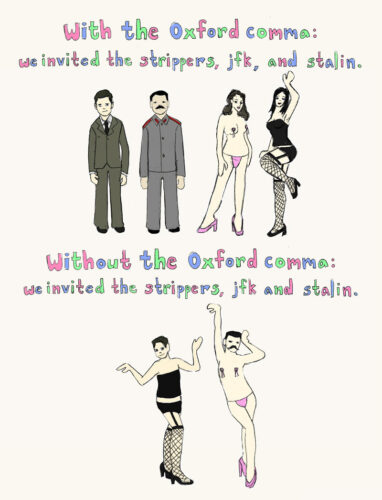
Now, I’m not saying JFK and Stalin were never strippers (imagine that scoop) but it’s unlikely that the writer meant to imply they were. A simple Oxford comma could have cleared it up.
So why the resistance?
Penny-Pinching & Print
Historically, the omission of the Oxford comma wasn’t about style at all — it was about money (isn't everything?). In the days of expensive printing, every character counted. Literally. A single extra comma cost as much to print as a letter, so cutting it made financial sense.
That tradition stuck, particularly in journalism. AP Style, the guide followed by most journalists, still advises against it — mostly, one suspects, for brevity's sake. Newspapers have limited space, and when words must be cut, a squiggle might seem expendable.
But today? In the age of digital publishing, automatic kerning, and infinite scrolls, there’s no real reason not to use it — except habit.
Just Rewrite It?
Critics argue that rather than relying on a comma for clarity, writers should simply reword their sentences. And in fairness, they have a point.
Take this reworked version of the stripper sentence:
We invited Stalin, JFK and the strippers.
Now we’re fine (and probably scandal-free). Similarly, the Mandela sentence could be rewritten for clarity without needing any extra punctuation.
But — and it’s a big but — why not use the comma? If it solves the issue with a single tap of a key, why make things harder?
A Confusing Counterpoint
The most convincing anti-Oxford-argument I’ve found comes from Gus Lubin at Business Insider, who says the Oxford comma doesn’t always solve ambiguity. He tweaks the stripper sentence to make his point:
We invited the stripper, JFK, and Stalin.
Now we’re left wondering: did we invite three people (a stripper, JFK, and Stalin)? Or two (a stripper named JFK and Stalin)? It’s not perfectly clear.
Touché, Gus.
But honestly, I still think these cases are the exception. Most confusion comes from omitting the Oxford comma, not including it. So while I acknowledge this rare ambiguity, I still believe the comma is worth its weight in squiggles.
Besides, I just can’t bear a naked ‘and’.